B2B customer onboarding: a process to stop early churn
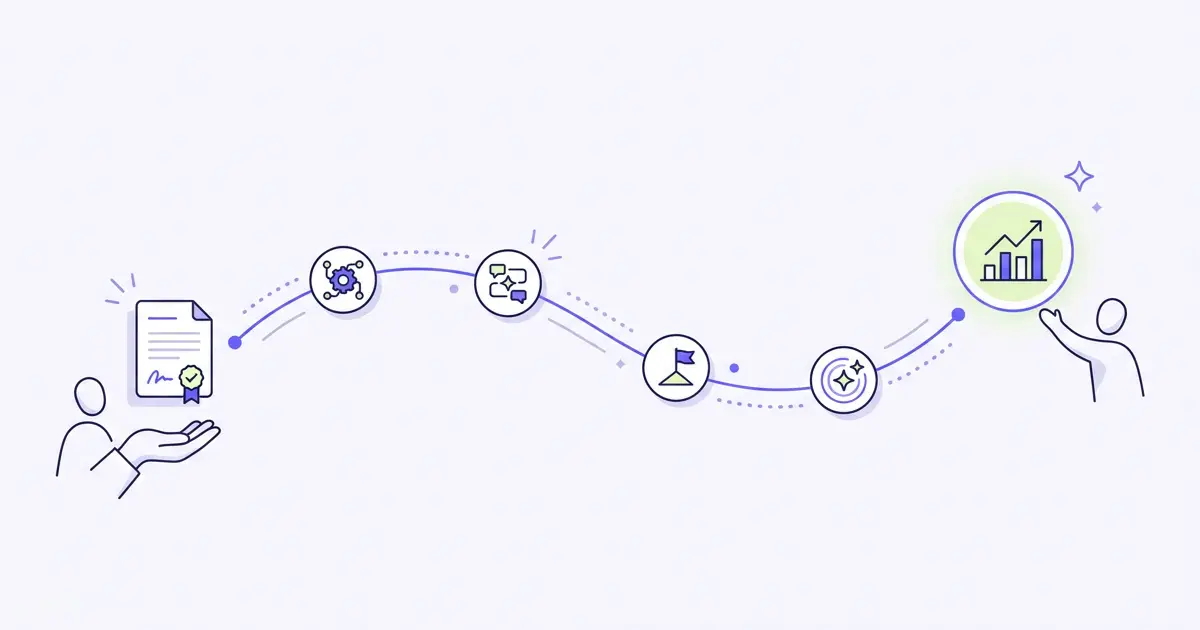
Good B2B customer onboarding is not a setup checklist: it is the shortest path between what the customer was promised during the sale and the first business result they can show internally. To reduce early churn, write that result down with the customer before kickoff, name an owner on each side and measure how many days it takes to get there. If the customer doesn't see value in the first few weeks, you start losing the renewal long before the renewal date.
Why early churn is almost never a product problem
When a customer leaves in the first few months, the usual explanation is "they didn't use the tool". But there is almost always something earlier: nobody agreed on what using it well would mean.
The sale is about outcomes: saving hours, fixing a process, having data to decide. Onboarding is often about setup: users created, integrations connected, training delivered. Between those two conversations there is a gap. The customer finished onboarding according to your checklist, but not according to their boss.
I lived this with a customer in the gaming industry. We completed every item on the onboarding checklist: configuration, integrations, training. In our system, onboarding was done. For the customer, it had been a failure. We had trained the wrong people: those who would use the tool every day had not been involved. And before we started, we never checked their expectations, so it wasn't clear what success meant either. We did everything we had planned, but not what the customer needed.
The practical consequence is that more tutorials won't fix it. What fixes it is designing onboarding backwards from the customer's outcome.
Step 1: define "onboarded" with the customer, in writing
Before kickoff, write on one page what has to happen for the customer to say "this is already working for us". It has to be something they can show, not something you can tick off.
A good definition has four parts:
- The business outcome: what changes for the customer. For example, "the collections team stops building the weekly report by hand".
- The evidence: what it will look like. "Monday's report comes out of the tool, no spreadsheets".
- The target date: when it should happen. Agreed, not imposed.
- Who confirms it on the customer's side: ideally whoever signed or owns the outcome, not just the user doing the setup.
If you can't fill in these four lines, you don't yet know what you are onboarding. That uncomfortable conversation belongs in week one, not month eleven.
Step 2: fix the handoff from Sales to Customer Success
Onboarding starts in the sale. Everything that was promised, doubted or negotiated has to reach the team that will work with the customer.
A useful handoff answers, at a minimum:
- Why did they buy? What problem hurts today?
- What were they promised, in those exact words?
- Who decides, who uses it and who can stop the project?
- Which objections are still open?
- What date does the customer have in mind to see results?
The common mistake is a free-text CRM field that nobody fills in. A short meeting between whoever sold and whoever will onboard works better, with these questions as the agenda and one rule: the customer should never have to repeat to Customer Success what they already told Sales.
Step 3: design the path to first value, not a training syllabus
With the definition of success agreed, map the shortest path to get there. For each step, ask whether it brings the customer closer to that outcome or whether it's "just in case" setup.
A simple outline:
| Stage | Goal | Customer owner | Our owner |
|---|---|---|---|
| Week 1 | Kickoff: validate the definition of success and the plan | Sponsor | CSM |
| Weeks 2–3 | Minimum setup for the first use case | Technical lead | CSM / implementation |
| Weeks 3–4 | First visible result | Key user | CSM |
| Day 60–90 | Review with the sponsor: did we achieve what we agreed? | Sponsor | CSM |
Timelines depend on your product and the size of the customer. What matters is that each stage has a named owner on both sides. An onboarding where everything depends on your team moves fast in the slide deck and stalls in reality.
Step 4: measure time to first value and watch the early signals
If you could measure only one thing, make it this: how many days pass from signature until the customer achieves the result you defined together. That number is usually called time to value.
There are also signals that predict trouble long before any usage metric:
- The sponsor stops showing up to meetings.
- The date of the first result moves twice.
- The technical lead changes or disappears.
- The customer's questions are about setup, never about outcomes.
When one of these appears, don't wait for the quarterly review. Ask for a conversation with the sponsor and go back to the definition of success: is it still the right one? What is getting in the way?
In my experience, bringing these conversations forward is what reduces early churn the most. The key is that they solve the problem instead of postponing it: a sponsor meeting that ends with "let's look at it next time" is not an intervention, it's another risk signal. Every conversation has to close with a decision and an owner.
Common mistakes we see (and how to avoid them)
Calling onboarding done when training is done. Training is a means. Onboarding ends when the customer confirms the agreed outcome.
One onboarding for every customer. A small customer and one with five departments involved don't need the same journey. Define two or three paths by complexity, not by how much they pay.
Measuring activity instead of progress. The number of meetings, emails or tickets doesn't tell you whether the customer is closer to the outcome. There is only one weekly question: what's missing for first value, and who unblocks it?
Leaving the sponsor out. If the person who bought isn't part of the kickoff or the final review, nobody will defend the renewal when it comes.
What you can do this week
- Take the last five customers who left in their first year and ask yourself: did we have their definition of success in writing?
- Write the one-page template with the four parts (outcome, evidence, date, who confirms) and use it in your next kickoff.
- Get Sales and Customer Success together for 30 minutes to agree on the minimum handoff questions.
If the problem runs deeper, for example if it's unclear where customers are lost or each team tells a different story, that's what we review in a Customer Success audit. A first conversation is enough to know whether you need one.
Frequently asked questions
How long should B2B customer onboarding take?
It depends on the complexity of the product and the customer, but the useful approach is to set the length based on the first agreed outcome, not a standard calendar. For simple products it can be a matter of days; for implementations involving several departments, one to three months. If there's no visible first result in the first few weeks, it's worth reviewing the plan.
Who owns onboarding: Sales, Customer Success or Implementation?
Customer Success usually leads it, but the outcome depends on all three. Sales owns a complete handoff, Implementation owns the technical side and Customer Success owns getting the customer to the agreed outcome. What matters is that each stage has a single named owner.
Which onboarding metrics should we track?
Start with time to first value (days from signature to the agreed outcome) and the percentage of customers who reach it by the planned date. Then add risk signals such as sponsor changes or slipping dates. A few well-defined metrics are worth more than a crowded dashboard.
Can B2B customer onboarding be automated?
You can automate reminders, in-product guides and the repetitive parts of setup. What you shouldn't automate is the definition of success or the conversation with the sponsor: that's where it's decided whether the customer stays.